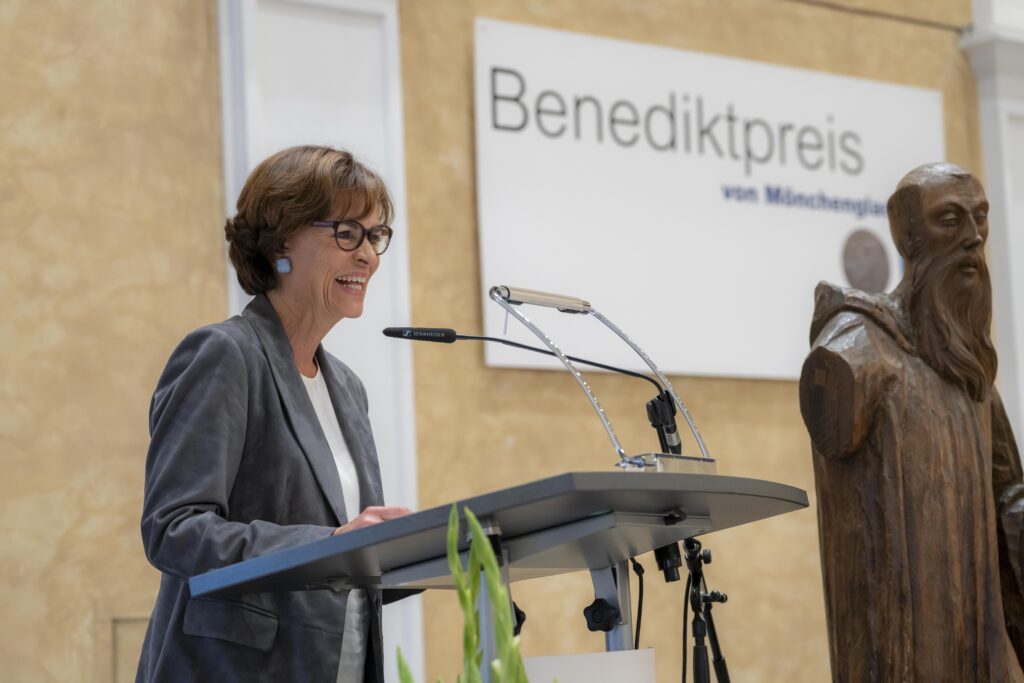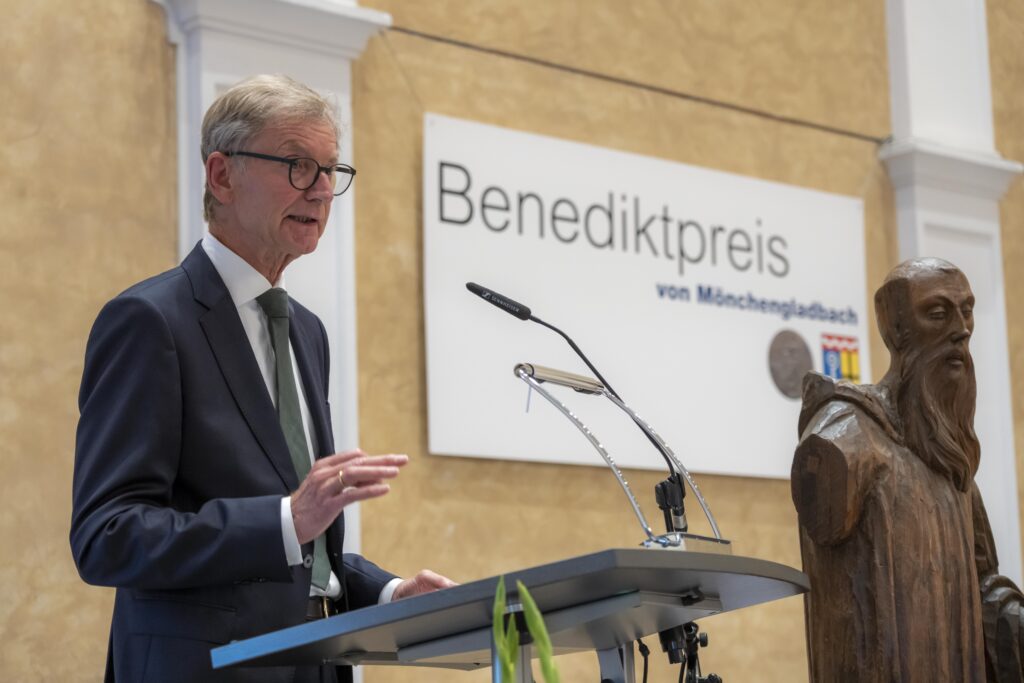


The spoken word shall prevail.
Dear guests,
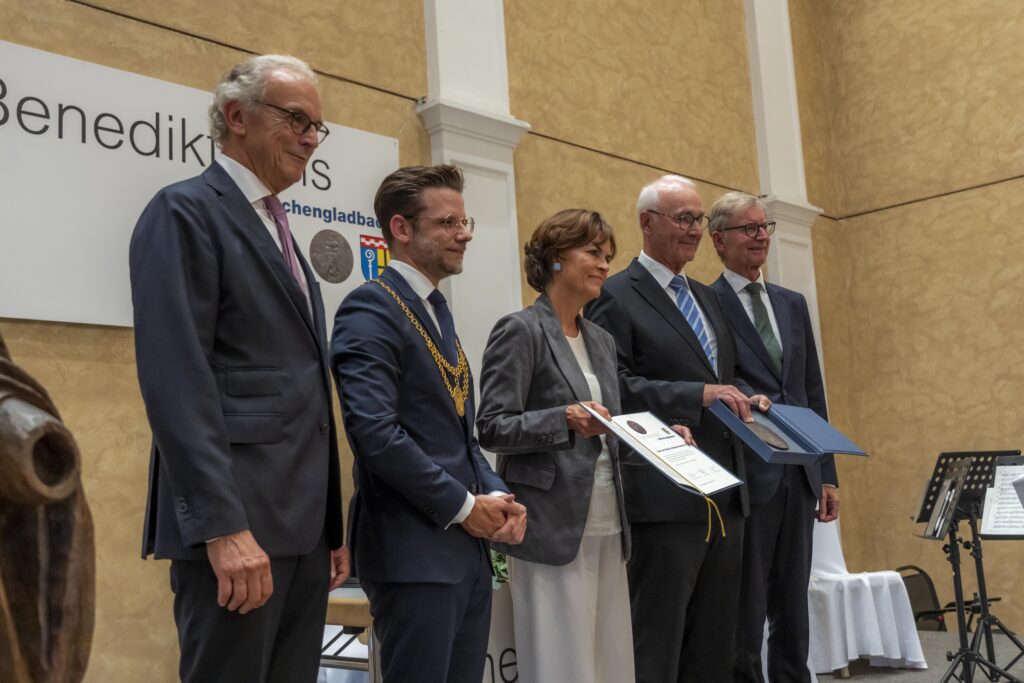
I warmly welcome you to the Benediktpreis award ceremony: A special award
for an extraordinary laureate: Professor Nicola Leibinger-Kammüller.
I also welcome the guests from federal, state, and local levels, Dr. Erdland
as laudator, and the members of the Executive Board and Board of Trustees of the association “Benediktpreis
von Mönchengladbach.” I am particularly pleased that Mayor Yolanda
Hoogtanders from our partner city of Roermond is also participating in the ceremony.
My sincere thanks go to the string quartet of our city’s music school for the calm opening
with great expression, and to Gladbacher Bank for its valuable support.
Dear Professor Leibinger-Kammüller, dear Dr. Kammüller, I warmly
welcome you to “Mönchen-Gladbach.” A city whose very name serves as a
visible reminder of the Benedictine monks who came here more than a thousand years
ago and founded a spiritual center on the Abteiberg. On that very
Abteiberg where we are currently located. Perhaps we can sense something of this
spiritual heritage, of this atmosphere, if we allow ourselves to reflect on it a little.
With the founding of St. Vitus Abbey in 974, a place was created from whose
surroundings our city developed. No monks, no city. At least not in
this location and not in this form. We owe a great deal to the Benedictines.
They shaped Mönchengladbach for more than eight centuries – spiritually and culturally,
economically and socially. The abbey was a place of faith, but
also a place of knowledge, work, preservation, and creation. And when
we look back at this history today, we do not do so with the wish
to restore past times. We do it because history can tell us something about the
values from which communities emerge. And it can give us orientation.
“Meaning-making through temporal experience” – as the historian and cultural scientist
Jörn Rüsen expresses it.
The special thing about traditional values is that they still apply today. Because there is
no expiry date for the fundamental values of human coexistence. They apply
universally. And connect us with generations before – and I hope also: – after us.
Values that are agreed upon – whether in a company, family, or society –
do not always have to be re-discussed. This creates a secure basis on
which everyone can act. And if everyone adheres to them, it builds trust, confidence,
and strong internal cohesion. In your family, dear Ms. Leibinger-
Kammüller, there is a – I believe – leather folder in which the family code is summarized,
and which every family member ceremoniously receives and signs at the age of 16.
A wonderful symbol for the transmission of values and keeping them
alive.
Perhaps it is precisely the Benedictine tradition that reminds us that a
society needs more than the striving of the individual. It needs community. It
needs responsibility. It needs moderation. It needs education and culture. And it
needs the willingness to preserve what has been entrusted to us – and at the same time
the courage to develop it further. This is a message that extends far beyond the boundaries of a
religious tradition. Because even a modern, open, secular, and diverse
city thrives on people being willing to take responsibility for the whole.
Viewed this way, our Benedictine roots are not a look back. They are a mandate
forward. A mandate to remind us that a city is more than its buildings,
its streets, and its administration. A city is a community of people
who share a common history and who look forward together.
Precisely therein lies the timeless power of our Benedictine heritage. Or, to put it another way:
Preserve what sustains. Be responsible for what is entrusted to us. And have the courage
to shape the future.
And here, the look back becomes a look forward. As a city undergoing structural change,
Mönchengladbach plays a significant role in the Rhenish Mining Region. With projects
in economic development, innovation, education and training, climate change adaptation,
and sustainable urban redevelopment, energy, heating, and mobility transition,
we are investing, thanks to public funding and private initiative, a three-digit
million amount in the coming years alone. While the Minster with the
Abbey Town Hall stands for the Benedictine tradition, for example, the knowledge
and innovation campus, Textile Factory 7.0, and the later opencast mine lake will be places
of responsible and value-based engagement with the challenges of the
future.
This is precisely where the Benediktpreis comes in: It takes up this historical heritage,
brings it into
our time, and gives it a contemporary form of expression. It helps to preserve the values
associated with this tradition and to carry them into the future.
The Benedictine tradition also shows us that spiritual values and economic
action do not have to be opposites, because the abbey was also an economic actor
with land ownership, farms, mills, and other sources of income. The Benedictines
stood for moderation, order, responsibility, and respect for creation. Economy
is not a value-free space. The Christian view of humanity, to which you, dear
Ms. Leibinger-Kammüller, also feel very committed, provides an important counterpoint to
a purely economic perspective: Humans are not primarily labor,
customers, consumers, or cost factors. They possess inalienable dignity.
The economy is sustainable when it serves people – and not people serving
the economy alone. Entrepreneurship thrives on courage, initiative, and freedom.
A freedom for which the state must create the framework conditions. A principle
of Christian social teaching also offers interesting guiding principles for a modern economy:
subsidiarity. People and companies should be able to act as independently as possible.
The state cannot and must not take everything upon itself. But freedom
also requires responsibility – and solidarity.
You, esteemed Ms. Leibinger-Kammüller, live this responsibility as Chairwoman of the
Management Board and shareholder of the globally active mechanical engineering company
Trumpf Group in Baden-Württemberg. Your employees, for example, benefit
from parent-friendly working conditions through a special, flexible
working time model. Your experiences as a working woman, mother of four children,
and manager simultaneously have also shaped your leadership style.
You have led your international company, which is still a family business
and should remain so, through crises with clear, transparently communicated decisions:
economic crisis or Corona. You did not lay off anyone during that
time; instead, you proactively invested a lot of money – including private funds –
and used the time to offer targeted training to your employees.
That was an enormous success factor. And continuity in company management
was a stability factor.
Outside the company, you are also involved in many ways. Your expertise is highly
sought after. You have therefore already been honored for your contributions to a fair and
transparent corporate and leadership culture, for your personal commitment in the
areas of economy, education, and society, as well as your civic engagement.
As a doctor of literature, art and culture are also a matter of the heart for you.
Your impact is enormous.
You combine the courage of an entrepreneur with the reliability of your actions. Your
willingness to perform is closely linked to solidarity, and your innovation
always bears the stamp of responsibility. Furthermore, you pursue a corporate philosophy
in which trust is an important asset. Trust that a
word holds true. That your company stands by its responsibility. That leaders
do not abuse their power. That contractual partners are treated fairly despite competition.
Trust is perhaps the oldest and at the same time most valuable capital of our
economy. It cannot be traded on the stock exchange. It must be earned anew every day.
And you, dear Ms. Leibinger-Kammüller, do that very successfully.
You always consider economic strength against the backdrop of social
responsibility. That is Christian in the best sense. That is also profoundly European. And
it is an attitude that is of lasting importance for a modern, cosmopolitan society.
Thank you very much – also in the name of Saint Benedict.