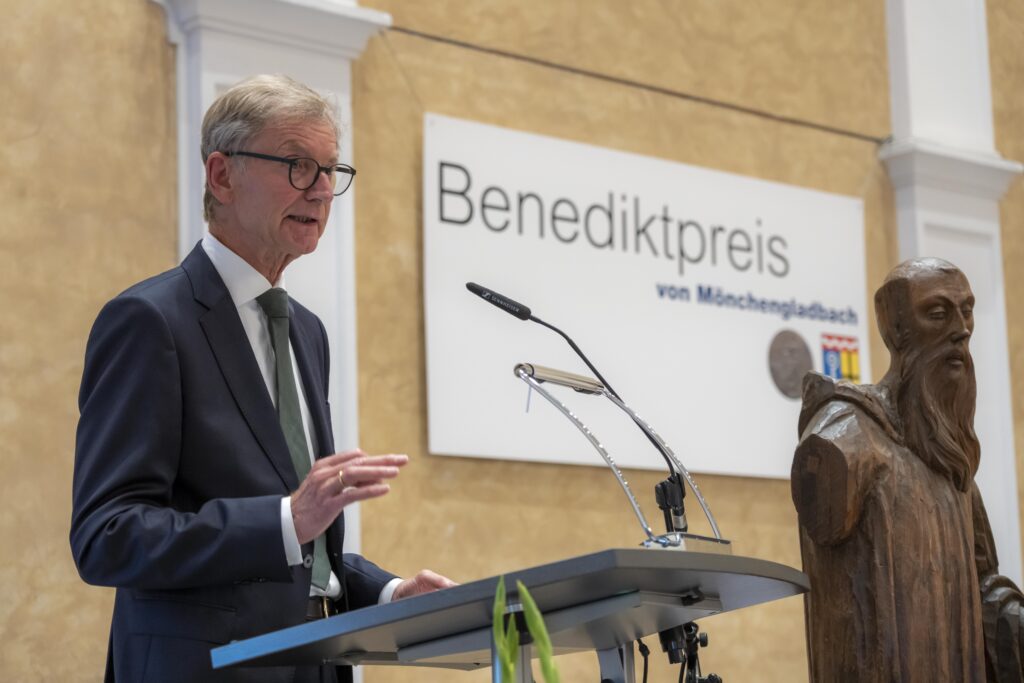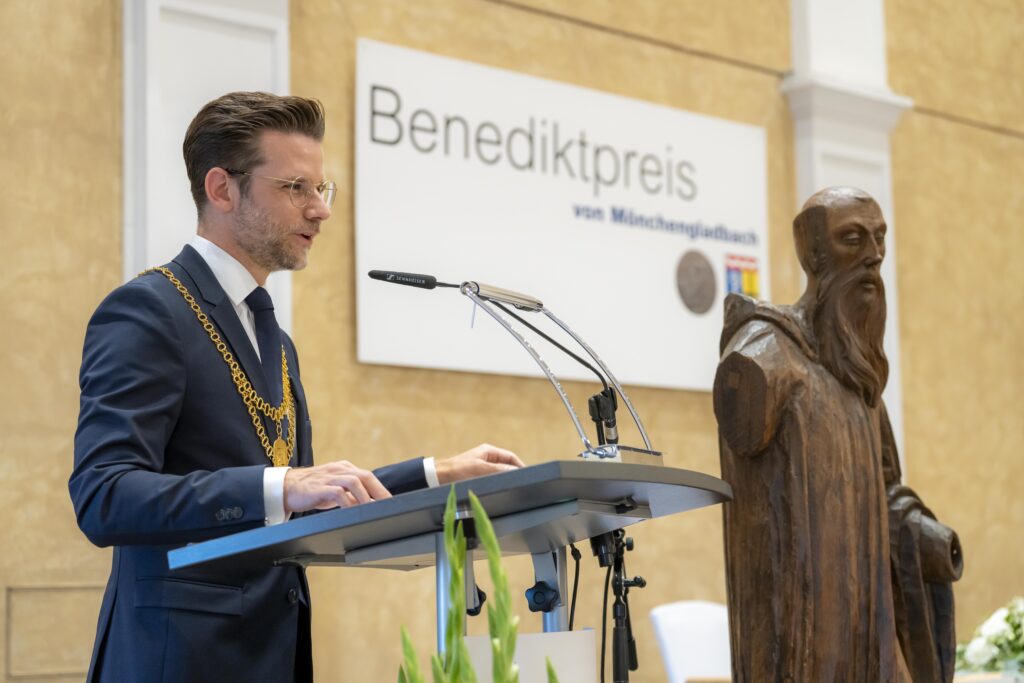


The spoken word shall prevail.
Dear Mr. Harnacke,
dear Professor Kania,
dear Lord Mayor Heinrichs,
dear members of the Board and the Board of Trustees,
ladies and gentlemen,
above all: dear Dr. Erdland!
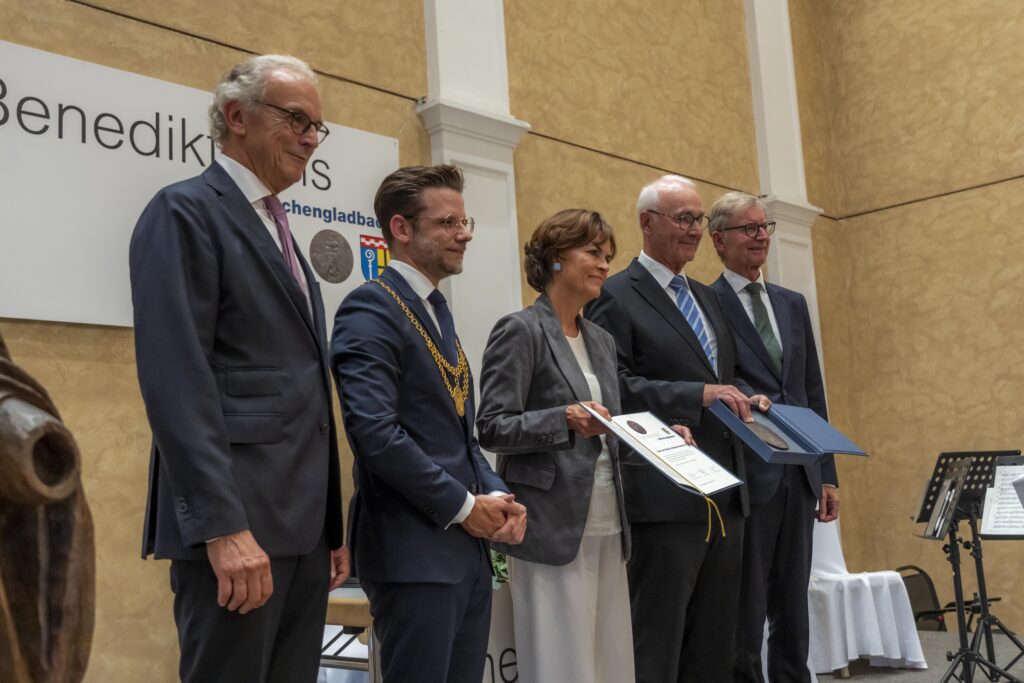
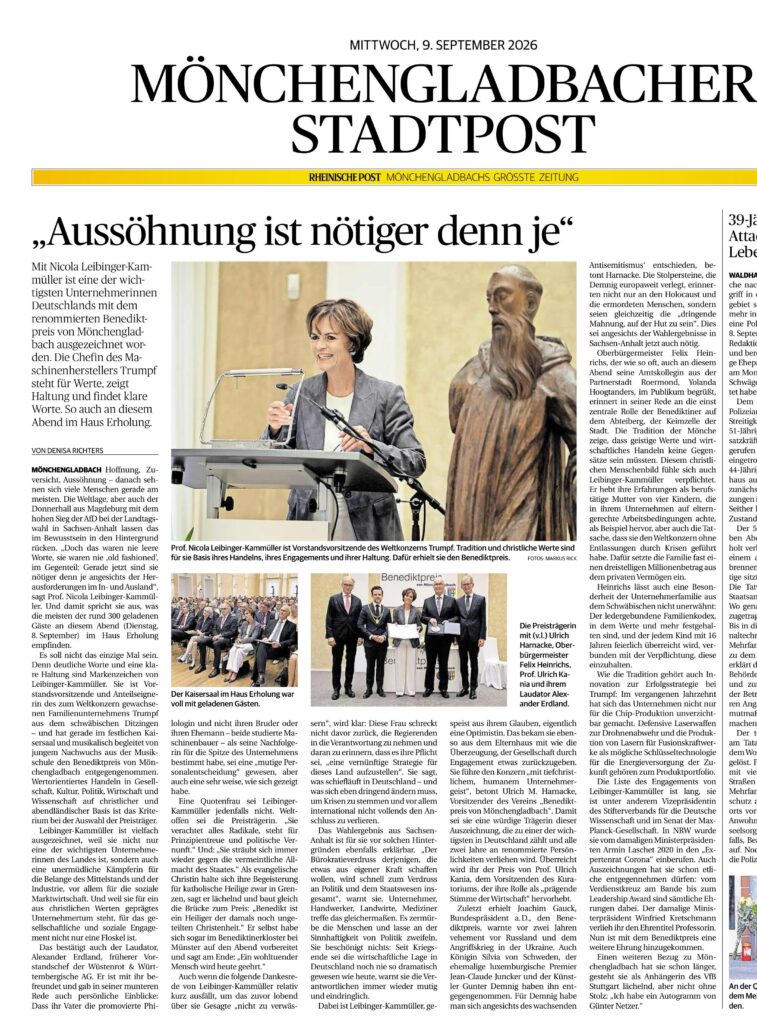
I thank you very much for the honor of the Benedict Prize 2026 and the words spoken in this context! This recognition, both the verbal tribute and the prize itself, means a great deal to me. And not least in view of the list of distinguished names of other prize winners in recent years…
I thank the jury under the leadership of Professor Kania all the more for your vote. And I thank you, dear Alexander, for your more than benevolent, indeed touching and heartfelt words—and for engaging so thoroughly with the prize winner! But also you, Mr. Harnacke and Mr. Heinrichs, for your welcoming remarks!
You have all more than lived up to the spirit of “benedicere”—that is, saying something good, perhaps even flattering, to someone else.
And if only a fraction of what the audience has just heard about tonight’s honoree should prove true, if therefore—as is customary on such occasions—exaggeration was not the legitimate stylistic device of choice that guided the hand of the writers in their manuscripts, it would be a joy to me. And a blessing. For that, as I said, my heartfelt thanks!
I.
At the same time, I cannot hide my Protestant disposition in light of the speeches this evening.
A response to greetings and laudatory speeches, even such splendid ones as Dr. Erdland’s, should—if it must be given at all—definitely be brief and marked solely by gratitude. Not to say: by humility.
It should under no circumstances succumb to the temptation to expound too much on one’s own behalf. This would be highly inappropriate, it seems to me. For it would dilute what has been said before. Rob it of its singularity.
Therefore, esteemed laudator, esteemed guests, the honoree will indeed be brief, not out of intellectual laziness, but solely out of courtesy with regard to all that has already been said. And she deliberately repeats herself:
I thank you very much for appearing at this occasion this evening, in part on my account!
You could be doing other things in this venerable city, which—like many other Swabians, I beg your pardon—was familiar to me primarily because of your legendary football club and many victories and defeats against VfB Stuttgart in earlier times, when everyone in Ditzingen knew the names Netzer, Rahn, or Lienen…
May the credo of the Benedict Prize, which also represents a certain obligation for every prize winner, contribute something in these times marked by discord and global uncertainty to moving things in a better direction!
II.
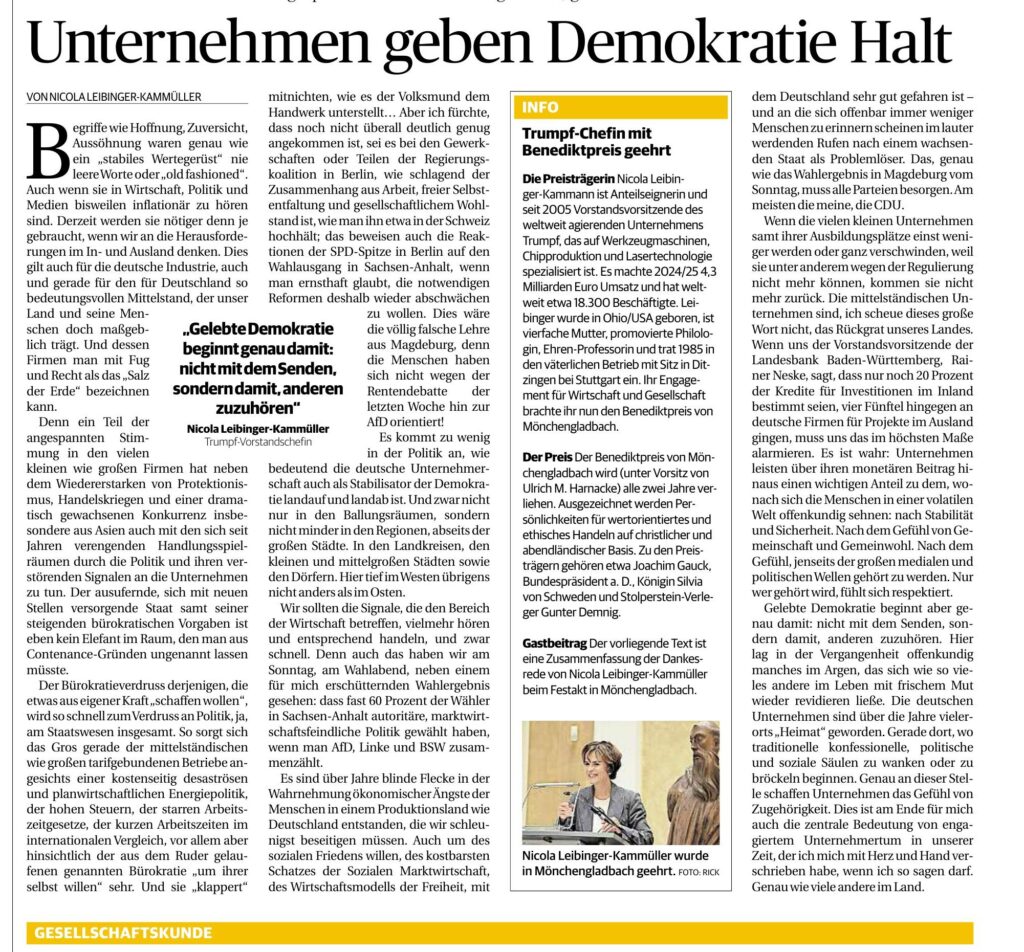
Ladies and gentlemen: Concepts such as hope, confidence, reconciliation, which are associated with this prize, were never empty words or “old fashioned,” just like a “stable framework of values.” Even if they are sometimes heard with inflationary frequency in business, politics, and the media.
On the contrary, it seems to me that they are needed more than ever at present, when we think of the challenges at home and abroad that are well known to all of you.
This applies—if I may add as a businesswoman—also to German industry, which I may represent to some extent this evening. Also and especially to the medium-sized businesses so significant for Germany, which substantially sustain our country and its people. And whose companies can rightly be called the “salt of the earth,” to build a linguistic bridge to the denominational content of today’s prize.
For part of the tense mood in the many small and large companies is due not only to the resurgence of protectionism, trade wars, and dramatically increased competition, particularly from Asia, but also to the narrowing room for maneuver caused by politics and its disturbing signals to businesses over the years.
You all know this as well: The sprawling state, staffing itself with new positions along with its rising bureaucratic requirements, is not an elephant in the room that must go unnamed for reasons of propriety.
III.
The frustration with bureaucracy among those who want to “create something” through their own efforts quickly becomes frustration with politics, indeed, with the state as a whole. Entrepreneurs, craftsmen, farmers: It is rare that I publicly recommend an ARD television program. But perhaps you should watch the documentary “Land unter Druck” (Country Under Pressure) with voices from crafts, agriculture, health, transport, local politics, and sports in the run-up to the state elections in Saxony-Anhalt, Mecklenburg-Western Pomerania, and Berlin, to understand what really wears people down in Germany in everyday life—and often leaves them despairing in the face of the meaningfulness of so many state regulations.
It aired on August 31 after the “Tagesschau” and can be found in the media library. And if I may add: My husband and I could not believe our eyes and ears that such unflinching words were heard on ARD at prime time…
Thus the majority of medium-sized and large companies bound by collective agreements—back to the German economy—are very worried in view of a disastrous and centrally planned energy policy in terms of costs, high taxes, rigid working time laws, short working hours by international comparison, but above all with regard to the aforementioned bureaucracy that has run amok “for its own sake.” And it does not “rattle,” as the saying famously attributes to craftsmanship…
But I fear that it has not yet become clear enough everywhere, whether among the trade unions or parts of the governing coalition in Berlin, how striking the connection is between work, free self-development, and social prosperity, as upheld in Switzerland, for example; this is also proven by the reactions of the SPD leadership in Berlin to the election outcome in Saxony-Anhalt, when they seriously believe they should weaken the necessary reforms again for that reason. This would be completely the wrong lesson from Magdeburg, because people did not turn to the AfD because of last week’s pension debate!
Too little is getting through in politics about how significant German business is also as a stabilizer of democracy throughout the country. And not only in the metropolitan areas, but no less in the regions, away from the big cities. In the rural districts, the small and medium-sized towns, and the villages. Here in the far west, by the way, no different than in the east.
IV.
We should rather hear the signals concerning the economy and act accordingly, and quickly. For we also saw on Sunday evening, alongside an election result that I found shattering, that almost 60 percent of voters in Saxony-Anhalt voted for authoritarian, anti-market policies, if you add up AfD, Die Linke, and BSW:
Blind spots have emerged over the years in the perception of people’s economic anxieties in a production country like Germany, which we must eliminate as quickly as possible. Also for the sake of social peace, the most precious treasure of the Social Market Economy, the economic model of freedom with which Germany has fared very well—and which fewer and fewer people seem to remember amid the growing calls for an expanding state as problem-solver. That, just like the election result in Magdeburg on Sunday, must concern all parties. Mine, the CDU, most of all.
I say it very clearly: If the many small companies along with their training positions eventually become fewer or disappear entirely because, among other things, they can no longer cope due to regulation, they will not come back. We can see this in the decline of the U.S. machine tool industry, which today effectively no longer exists, which is why we have hardly any competition in the USA in this area, and if so, then Japanese.
The medium-sized companies are—I do not shy away from this grand word—the backbone of our country. When the CEO of Landesbank Baden-Württemberg, Rainer Neske, tells us that only 20 percent of loans are intended for domestic investment, while four-fifths go to German companies for projects abroad, this must alarm us in the highest degree.
V.
In this respect, it pleases me in several ways that you are honoring a businesswoman this evening who understands herself first and foremost as a citizen and a Christian. For with this choice you are also saying: The economy, and especially the manufacturing medium-sized sector, are essential for our country.
It is true: Beyond their monetary contribution, companies make an important contribution to what people in a volatile world evidently long for: stability and security.
The feeling of community and the common good.
The feeling, and now comes the decisive point, of being heard beyond the great media and political waves.
Only those who are heard feel respected in the end. And as part of that democratic order to which they are constantly reminded.
But lived democracy begins with exactly that: not with broadcasting, but with listening to others. In the past, some things were clearly amiss here that could be reversed with fresh courage, like so much else in life.
I go even further, ladies and gentlemen, and sharpen the point: German companies have become “home” in many places over the years. Especially where traditional denominational, political, and social pillars begin to waver or crumble.
It is precisely at this point that companies create the feeling of belonging.
This is ultimately for me also the central significance of committed entrepreneurship in our time, to which I have devoted myself with heart and hand, if I may say so. Just like many others in the country.
VI.
In this spirit: I thank you for your attention.
To you, dear Alexander Erdland, who have successfully shaped a completely different industry over decades, namely the insurance industry, and today run a family agricultural business, I thank you especially for your empathetic words!
And I thank the jury once again for this award in the name of Saint Benedict of Nursia. He was indeed a Catholic and doubtless had no idea of “medium-sized businesses” in today’s sense. But he knew about the blessed union of work and faith, which for many denominationally oriented family businesses in Germany remains the decisive guiding principle of life. Especially in Swabia, of course—you will surely forgive me a trace of regional patriotism at the end..
Thank you very much!