


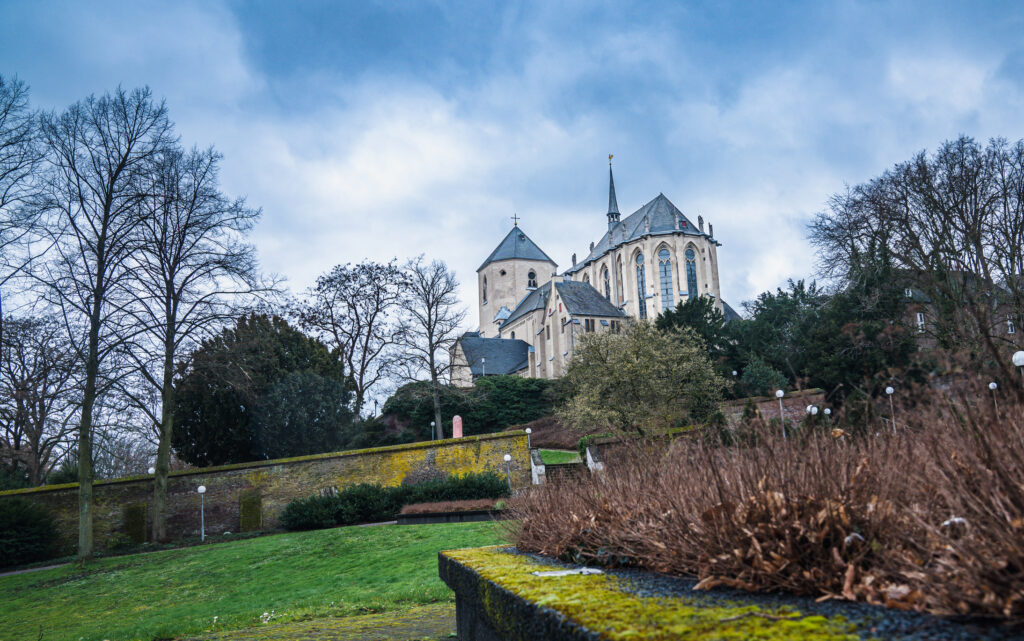
The Benedictines in Mönchengladbach
A city in the Benedictine tradition
Signposts sometimes show the way, even when they are wrong. The name of our city then appears in abbreviated form: M’gladbach. Yet it is precisely the part that is shortened that matters, because it points to the history: Mönchengladbach!
For almost a millennium, the Benedictine monks of St Vitus Abbey shaped the fortunes of Mönchengladbach. Anyone strolling through our city will find, here and there, a stone adorned with the crook of an abbot’s staff. Such boundary stones marked the sphere of influence of the Gladbach monastery. Up to this point, the abbot had the final say. This involved more than spiritual rule; tangible economic interests were at stake. Many farms belonged to the abbey and were managed on its behalf and for its profit. Through their economic enterprise, the monks shaped life in the small town. Its inhabitants depended on the abbot’s skill in governance. Although, as the saying goes, life was good under the crozier, the abbot’s power was nevertheless great. He was reluctant to share it with the Duke of Jülich. Subjects had to swear obedience to both.
In 974, Benedictine monks with their abbot Sandrad came to the Gladbach to found a monastery there on behalf of the Ottonian imperial house. Behind this lay political considerations. The emperor’s power had to be secured in the west. The Benedictines were particularly well suited to this, as since their founding they have skilfully linked spirituality, politics and culture. The Rule of St Benedict is regarded as the foundation of Christian culture in Europe. “Pray and work” are the key words that formed an unmistakable symbiosis. What is usually forgotten is the Rule’s exhortation to read the Holy Scriptures. Those who prayed had to work. But those who worked also had to read. For this reason, the Gladbach monastery housed a valuable library and a Latin school, which offered at least one opportunity for education. After the abbey was dissolved in 1802 under Napoleon, the Minster church, the abbot’s prelature, the pilgrimage, and an outstanding treasury of relics remained as testimonies to the Benedictine past. Quite rightly, the chain of office of the Lord Mayor of Mönchengladbach once described the city’s development in four letters: A.M.A.I.: A Monachis Ad Industriam. Or, from the monks to industry—few phrases capture the history of the city of Mönchengladbach more succinctly.