

Commendation Speech by Minister President Hendrik Wüst, Member of the State Parliament, for former Federal President Joachim Gauck on the occasion of the awarding of the Benediktpreis Mönchengladbach 2024
The spoken word applies
Dear Lord Mayor Heinrichs, dear Professor Kania,
dear Mr. Harnacke,
dear members of the Board of Trustees and the Board of the Benediktpreis Association,
I greet the Members of the State Parliament Vanessa Odermatt and Jochen Klenner, dear Mayor Hoogtanders,
ladies and gentlemen, and above all: esteemed Mr. Federal President, dear Joachim Gauck,
“Ora et labora” – that is the motto of the Benedictines. The order that shaped the city of Mönchengladbach for centuries and gave it its name. The order after which the Benediktpreis is also named. “Ora et labora” – this motto also fits very well with the personality we are honoring today: “Pray and work.” Reflection and action. Today’s laureate Joachim Gauck embodies this in its purest form.
Joachim Gauck’s attitude and work are fundamentally rooted in his biography.
Even as a child, Joachim Gauck understood that behind the caring facade of the SED regime lay a brutal state apparatus. His own father was deported to Siberia in the early 1950s for alleged espionage and anti-Soviet incitement. He returned only after four years – a broken man.
From then on, Joachim Gauck made it clear how little he thought of this state. As a result, he was not allowed to study his preferred subjects – journalism and literature. That’s how it was in the GDR: anyone who dared to contradict, anyone who raised their voice, was to be belittled and kept down.
But Joachim Gauck refused to be belittled: In theology, he found a space for intellectual independence. A counter-design to life in a repressive state. He ultimately became an unmistakable preacher of freedom.
“We will stay if we are allowed to leave,” he called out at the Rostock Church Congress in 1988. But he himself did not think of leaving the country. His credo: Only from within, only through engagement, can something be changed.
After the end of the SED dictatorship, Gauck tirelessly fought to ensure that the Stasi files were not only preserved but also researched and made accessible. Joachim Gauck knows: A society must also confront its painful past. Only then can wounds heal.
Joachim Gauck’s answer to the repressions of the SED regime was clarity: in his own values, in his own attitude, in his actions. Clarity shaped his work as a pastor in the GDR, as a member of the first freely elected People’s Chamber of the GDR, and after the Peaceful Revolution, as head of the Stasi Records Agency.
Your clarity, dear Joachim Gauck, also distinguished you as our head of state. The political influence of a Federal President is limited. His most important tool is the word.
Joachim Gauck knew how to use it.
Esteemed Mr. Federal President, you initiated debates. You used the many encounters with people in all parts of the republic to bring these debates into the country. Never lecturing, but always questioning, always curious, always seeking encounter, always attentive to people.
You encouraged people and trusted them to endure even difficult things. And even as Federal President, you clearly spoke uncomfortable truths. Here, we say: He can speak plainly!
In early 2014, Joachim Gauck formulated an unusually clear and far-sighted position on Germany’s international role. This was before Russia’s annexation of Crimea, which violated international law, and before the Donbas War.
The core sentence of his speech at the 50th Munich Security Conference in January 2014 was: “The Federal Republic should engage earlier, more decisively, and more substantially as a good partner.” He warned against moral self-righteousness. Against hiding behind German history. Against the fact that inaction also has consequences. He urged that we Germans must do more for our own and international security.
Joachim Gauck anticipated much of what concerns us today. Russia’s brutal war of aggression against Ukraine has caused unimaginable suffering and severely shaken the European security architecture. Only since then have we in Germany seriously addressed the resilience of our democracy. Joachim Gauck’s warnings from ten years ago are all the more relevant and clear-sighted.
Dear Joachim Gauck, you encourage us to draw more positive conclusions from Germany’s post-war history and to trust ourselves. You remind us that we can be peaceful and resilient at the same time. Germany must relearn this ability. You have provided important and far-sighted impulses for this rethinking. Thank you very much, dear Mr. Federal President.
Unforgettable is your sentence from September 2015, at the height of the refugee crisis: “Our hearts are wide, but our capacities are finite.” At that time, you spoke from the soul of many people. Especially the committed mayors and many volunteers who felt the limits of their resilience. Many of whom were already overburdened
at that time. You chose these words, although – or perhaps precisely because – hardly anyone dared to say such a thing in the public debate at the time. You named a dilemma that continues to occupy us to this day – almost ten years later. To this day, our country is searching for a good balance between humanity and order in refugee policy. Your statement has remained groundbreaking. Had it become a guiding principle earlier: I am sure we would have fewer challenges in our country today.
Joachim Gauck has always understood our society as a civil society. As a society supported by citizens. As a society shaped by a vibrant democracy. Strengthening democracy at the grassroots is therefore one of his greatest concerns. Joachim Gauck advocates for tolerance, for a lively exchange with those who think differently. He warns against prematurely labeling uncomfortable positions as populism and excluding them from discourse. He insists that in all cultural and value conflicts, the necessary respect for the other person and their life’s achievements must be maintained.
Dear Mr. Gauck, the attitude you exemplify – curious, empathetic, and at the same time value-conscious and resolute – is forward-looking for our society. Your style – argumentative, but never confrontational – is the ideal of democratic coexistence. You remind us all that “democracy is not a political mail-order business” (speech at the end of his term in 2017) and therefore can only function if active citizens exert influence.
Democracy can only function if many citizens decide to focus on opportunities and potential instead of dangers and losses. If many citizens use the diverse possibilities of political shaping and experience them as effective and empowering. In your words: “The freedom of adults means responsibility.”
Dear Mr. Gauck,
you provided important impulses on many topics: On the question of equal opportunities in education
On the role of individual responsibility in the welfare state. To name just two.
Your faith in democracy’s capacity for learning is unshakable. Precisely because you painfully experienced dictatorship, you know the strengths of democracy. And you openly named and promoted these strengths abroad, without ever being didactic. Democracies are characterized by their ability to self-correct. That is their strength. Yes, democracy is usually strenuous, sometimes even frustrating. But through elections, participation in parties and associations, through co-determination or even protest, there is always the possibility to exert influence and to do better.
Today, more than ever, we need faith in the strength and capacity for action of our democracy. In Germany and Europe, too, many people are losing confidence that the state can cope with problems: concerning security, migration, economic policy.
It is our task as centrist democrats to use our policies to restore trust. It is our task to strengthen our democracy. We must inspire people for our democracy. People must feel in their hearts: There is nothing better than our democracy.
This year we celebrate 75 years of the Basic Law. A famous picture shows Konrad Adenauer, as President of the Parliamentary Council, signing the newly adopted Basic Law in Bonn with ink. The founding hour of our democracy. Scientists have succeeded in bringing our Basic Law into the form of synthetic DNA. Forensic scientists know: DNA is almost indestructible.
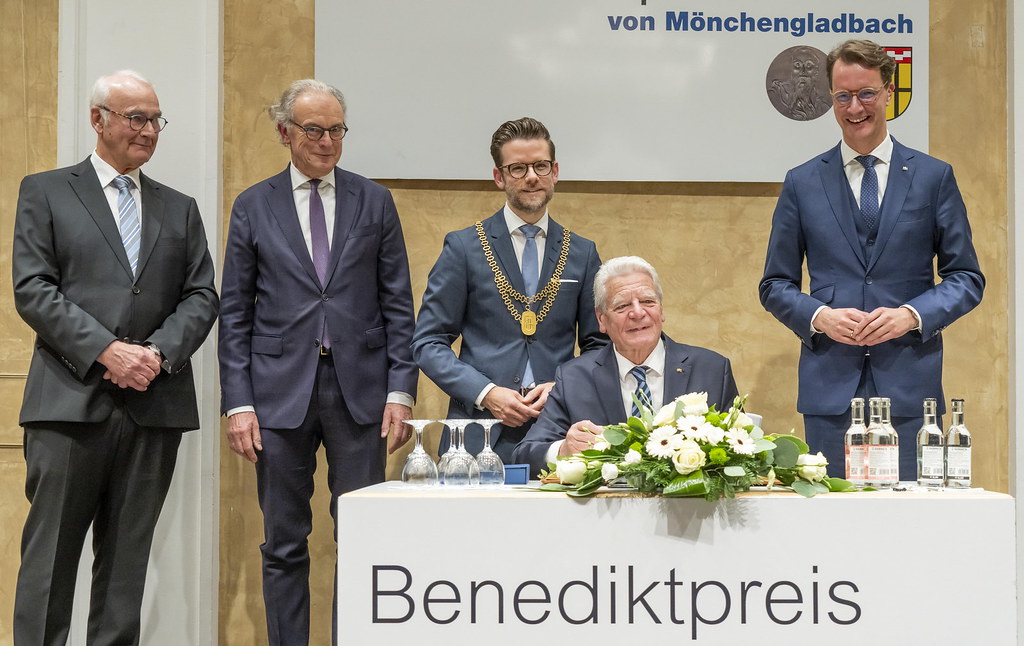
I have the pleasure and honor, esteemed Mr. Federal President, to present you with a fountain pen today. This fountain pen contains ink that holds this synthetic DNA and thus the entire Basic Law. That sounds a bit like science fiction. But it is true: Whoever deciphers this DNA has the entire Basic Law
before them. Whatever you write with this ink – the spirit of the Basic Law writes along. And with that, a beautiful circle closes: Because you, dear Joachim Gauck, stand for the values of this Basic Law and thus for our liberal democracy like hardly anyone else.
Joachim Gauck has now been Federal President (ret.) for seven years, as it is called in official German. But he is not out of service. Even shortly before his 85th birthday, he is extremely present: in public debate, through his speeches and appearances, through his visits to charitable initiatives and associations.
Joachim Gauck is someone who has something to say, whose word is heard and carries weight. Joachim Gauck is someone who not only impresses but inspires.
Esteemed Mr. Federal President, you are a human rights defender. You are an encourager. You give confidence: The prize you receive today stands for our Christian roots and for the civic achievements of the Enlightenment. Both traditions combine in your work for the good of our country: for a free and democratic Germany that trusts itself and stands up for what is good.
I warmly congratulate you on the Benediktpreis!