

The spoken word shall prevail.
Dear guests,
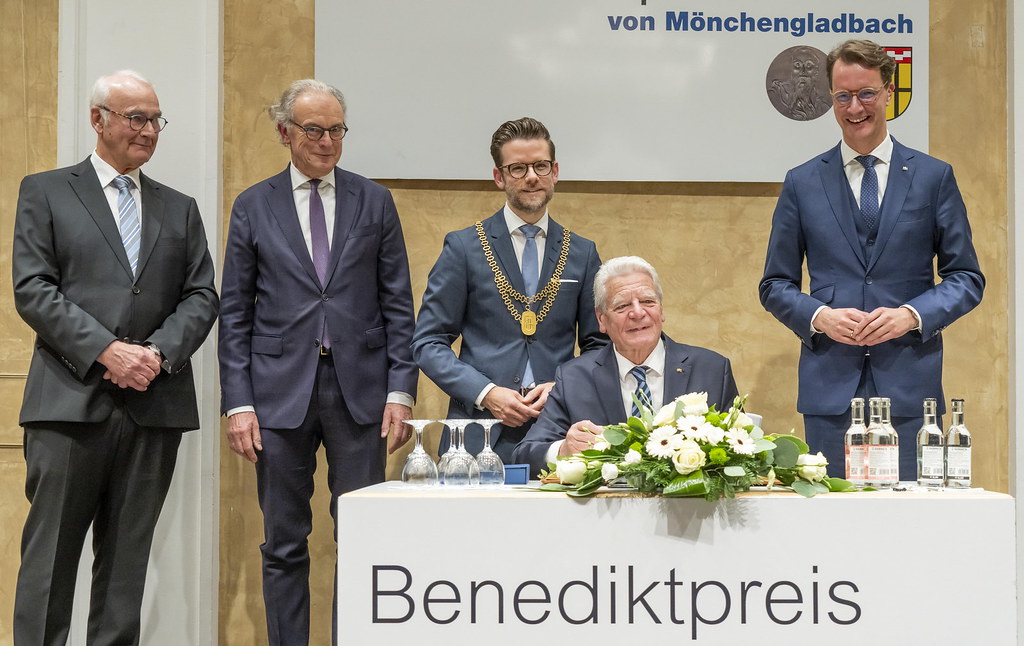
I warmly welcome you to Haus Erholung for the presentation of a special award to an extraordinary laureate. I am very pleased to welcome former Federal President Joachim Gauck and the Minister-President of the State of North Rhine-Westphalia, Hendrik Wüst, to Mönchengladbach.
I also welcome the guests from the federal and state levels, the Mayor of our partner city of Roermond, as well as the members of the Executive Board and Board of Trustees of the association “Benediktpreis von Mönchengladbach”. My sincere thanks go to the Vitus Quartet of the Lower Rhine Symphony Orchestra for the lively opening of this ceremony, and to Gladbacher Bank for its generous support.
Ladies and gentlemen,
at a time when seemingly everything is changing, it is good to recognize constants. The presentation of the Benedikt Prize here in Mönchengladbach is one such constant. For more than 828 years—between 974 and 1802—it was the monks who lived and worked here in this city. They devoted their earthly existence to following Saint Benedict, who had dedicated himself to pastoral care for people.
Most recently, the monks have once again come very much into this city’s awareness. Just a few metres from here, the Minster Basilica rests, lofty and watchful, over the city. Between the church and the former prelature building—today’s Abtei Town Hall—lies the Brunnenhof, which has now been made accessible to the public again thanks to great voluntary commitment, private donations, and a substantial grant from the State of North Rhine-Westphalia. During the work in this courtyard, where the old building structure with cloister and inner courtyards can once again be seen, the mortal remains of monks from the Middle Ages were found at the church wall and, after completion of the work, reinterred. Here lie the bones of people who carried out their work where we stand and walk today. In moments like these, I realise how little we all amount to—just a few millimetres on the measuring tape of time. Although we declare ourselves the centre of the world, we are nevertheless only fleeting actors in an incomprehensible eternity.
This thought must not lead us to regard our own actions as meaningless. No—quite the opposite. Even if we may be mere grains of sand in the great history of humankind, we are important beacons for our immediate surroundings, our families, our workplaces—and, in the case of a former Federal President, for our society as well.
You, dear Mr Gauck, have always understood how to be a role model. And therefore it is a special honour for me—and for all of us—to be able to welcome you to our city of Mönchengladbach today.
Recently, I immersed myself in your latest book, “Erschütterungen. Was unsere Demokratie von außen und innen bedroht”, which you published together with Helga Hirsch in 2023.
In it, with a view to global developments, you pose the provocative question (p. 8): “And would our society even be prepared, if necessary, to defend liberal democracy with determination?” I can tell you that people here on the Lower Rhine are taking a stand. On 25 January this year, around 10,000 people gathered just a few metres from here for a demonstration in support of democracy. For many of them, it was the first demonstration of their lives. And when, in May, two stones were thrown at facilities run by Lebenshilfe bearing the inscription “Euthanasia is the solution”, many people stood by—and also courageously in front of—the residents.
I cannot and do not wish to claim that our city is home exclusively to impeccable—let me use this term deliberately and provocatively—democrats. But these two events have strengthened the hope that we are in the clear majority.
However, we are looking at only a small section of our world. What does it look like in other parts? And—and I would not have thought that this question would once again arise so clearly—is it even our responsibility to stand up elsewhere for the values of a liberal democracy, for gender equality, for the protection of minorities? The current debate on development aid is bringing to light political statements that fit more under the motto “If everyone thinks of themselves, everyone is taken care of.” That troubles me. For we live in one world, and it is not by chance that we describe human rights with the adjective “universal”.
I ask: Are values tied to a place? Should it really matter whether I live as a woman in Germany or Afghanistan? Should it really matter whether I live as a democrat in the United Kingdom or Russia? Should it really matter whether I live as a queer person in New York or Tehran?
Please do not misunderstand me: this is not about cultural hegemony. I do not wish to dictate to any society or any country from a Eurocentric worldview. But when it comes to these fundamental values of human coexistence, there must be no differences between North and South, East and West.
You, esteemed Mr Gauck, have taken the following position on this (pp. 137–138): “For me, democracy will always remain associated with the moment of liberation from oppression and powerlessness.” And further: “For me, liberal democracy embodies a system that is committed to the inviolable dignity of the individual, a system in which everyone has the same rights, a system in which no one is prevented from shaping their life according to their own abilities and wishes—unless they harm others.” Your formulation of the categorical imperative should be an incentive for all of us not to look only at our own doorstep, but to support pro-democracy movements worldwide. For only a liberal democracy—won by people and defended in equal measure—provides the framework in which universal human rights can take effect, regardless of where on earth a person lives.
Dear Mr Gauck,
Mönchengladbach is the right city for you. People here are socially committed; this has been our tradition for centuries. We have just entered into a solidarity partnership with the Ukrainian city of Poltava. We have been linked to the Offinso District in Ghana through a development partnership since 2004. Recently, a youth parliament and a senior citizens’ council have been established. Friendly exchange with our European partner cities is currently flourishing again, and it is a great pleasure and honour for me to have my colleague from Roermond, Yolanda Hoogtanders, among our guests. In Roermond, the first shot on Dutch soil in the Second World War was fired. Today, we are closely connected in peace and friendship. What a wonderful twist of fate, founded on understanding between peoples after the horrors of the Second World War, which originated from German soil. For me, this is the greatest achievement of the statesmen and women in the heart of Europe after the end of the Second World War.
We are gathered here today not only to congratulate you, Mr Gauck. We have come together to remember the history of our city and to remind ourselves that it takes courageous people to stand up for the values of our liberal democracy. So that we can answer the question “And would our society even be prepared, if necessary, to defend liberal democracy with determination?” with unity and unwavering certainty: Yes.
Thank you very much, and congratulations!