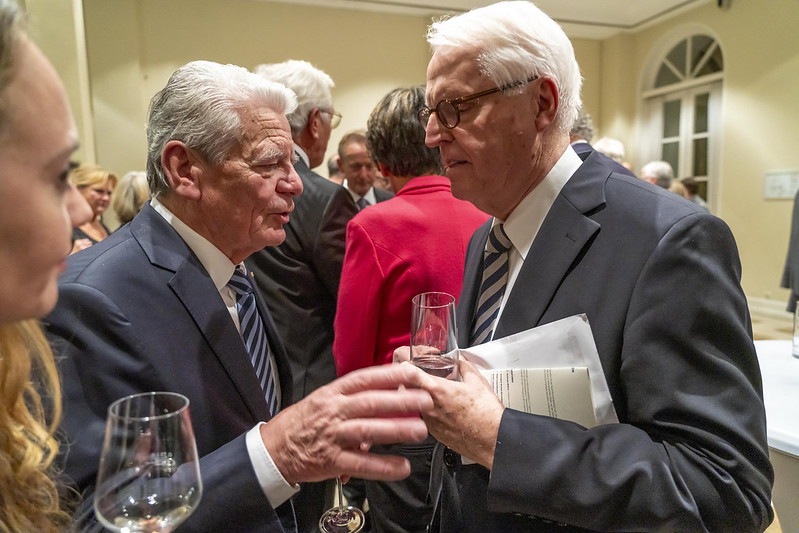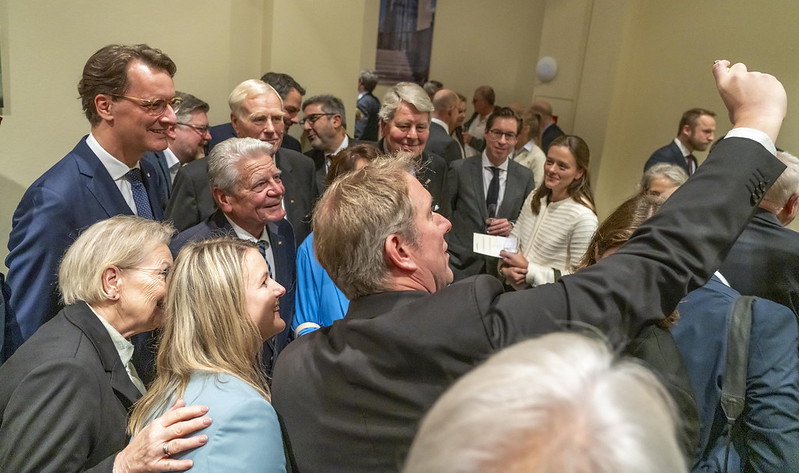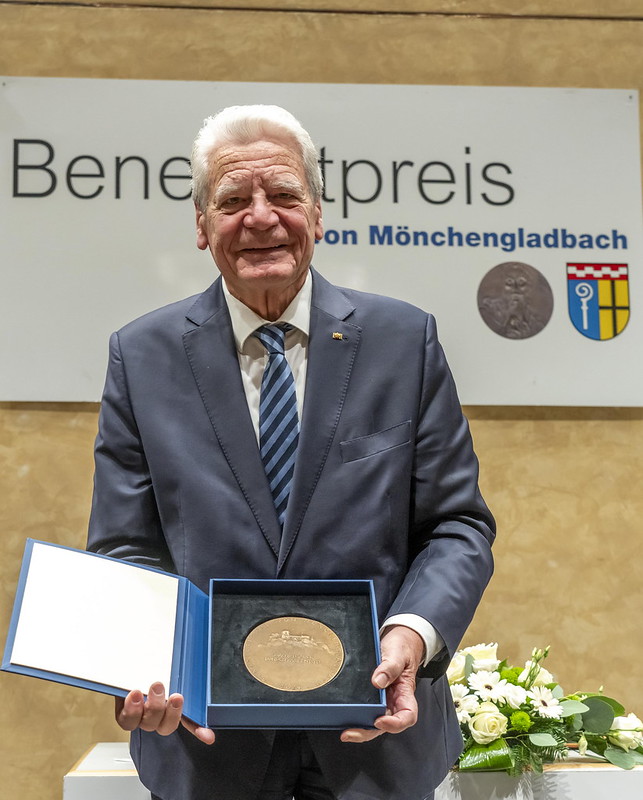


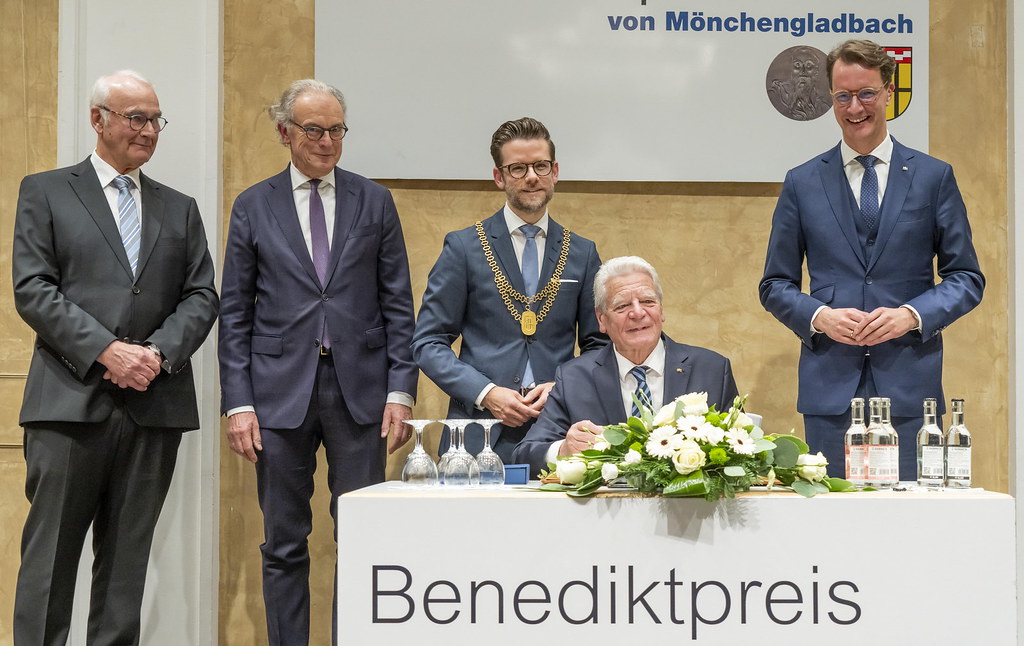
Former Federal President Joachim Gauck was honored on December 5, 2024, with the Benediktpreis of Mönchengladbach, one of the most important awards in North Rhine-Westphalia, before approximately 300 invited guests at Haus Erholung in Mönchengladbach.
In his laudatory speech, Minister-President Hendrik Wüst particularly highlighted Gauck’s commitment to a resilient democracy, freedom, and Christian values. He emphasized that Gauck always maintained a clear stance and did not shy away from speaking uncomfortable truths. As early as 2014, even before Russia’s annexation of Crimea, he had called for not hiding from German history and for a stronger commitment to national security and democracy. During the 2015 refugee crisis, he warned of the limits of resilience and urged a balanced but resolute stance, aiming for equilibrium between the demands of migration and human rights. Gauck was described by the eulogist as a human rights defender and an encourager who never chooses the path of easy consensus but instead advocates for the long-term preservation of values.
Gauck’s biography is strongly shaped by his experiences with a totalitarian system. Growing up in the GDR, he experienced the pressure of a socialist regime and became involved as an evangelical pastor in the church opposition. After the fall of the Berlin Wall, he took a leading role in the civil rights movement “Neues Forum” and advocated for the democratization of the former GDR. As chairman of the special committee for the dissolution of the Ministry for State Security, he played a significant role in ensuring that democratic values became a reality in this part of Germany. His ten years of service as Federal Commissioner for the Stasi Records reinforced his consistent liberal stance.
Even after his time as Federal President (2012-2017), Gauck continues to advocate for liberal democracy. In public statements and his books, he regularly warns of impending dangers, currently focusing particularly on cross-border, authoritarian tendencies in Russia and other states. Gauck’s Christian-influenced foundation of values forms the basis of his political convictions. He sees himself as a mediator who wishes to preserve confidence in the strength of democracy in an increasingly polarized world.
Mayor Felix Heinrichs praised Gauck as a personality who, through clear conviction and high commitment, has taken and continues to take responsibility for the state and society, serving as an exemplary reminder for the defense of democracy. His ideas, Heinrichs emphasized, are continually lived out in Mönchengladbach.
Ulrich M. Harnacke, Chairman of the Benediktpreis von Mönchengladbach association, recalled in his speech the namesake of the award, Saint Benedict of Nursia, who stands for the unity of faith and reason and sees himself as a bridge-builder between cultures, ideas, and people. These values, he stated, are as relevant today as they were in his time. Gauck, Harnacke added, shares these values. He consistently highlights the great good of freedom in responsibility and calls for trust in the strength of our democracy and the future viability of our country.
In his words of thanks, Joachim Gauck underscored this stance. In a remarkable speech, he focused on the threat to freedom and democracy posed by Russia under Vladimir Putin and its war of aggression in Ukraine, which he described as the greatest and most immediate threat to European security today.
The honoree, who has dedicated his life to freedom, democracy, and the rule of law, emphasized the particular importance of a stable, liberal-democratic, and resilient society in light of the almost dramatic threat to these values posed by the Russian war of aggression. He appealed to Western democracies to actively champion these values and particularly stressed the importance of courage and credible deterrence, extending to military resolve.
Gauck announced that he would donate the prize money of 5000 euros to support Ukraine, which, in his opinion, urgently needs the support of the Western world.
His remarks were met with a standing ovation.
The ceremony was musically accompanied by the Vitus Quartet of the Niederrheinische Sinfoniker and concluded with a reception in the function rooms of Haus Erholung.