

Check against delivery.
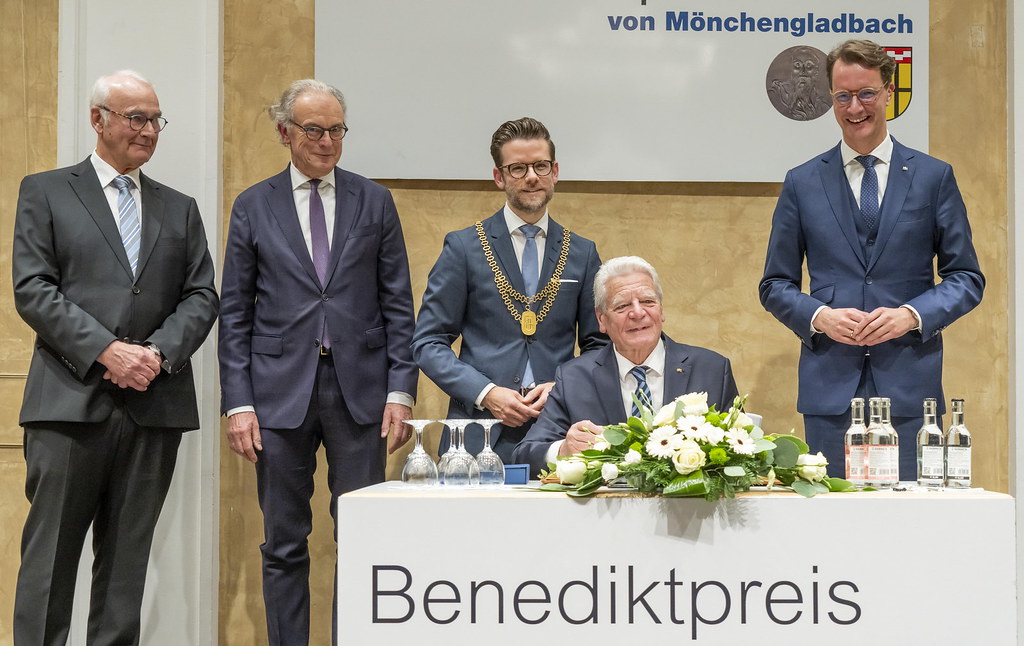
Thank you very much for this wonderful invitation to Mönchengladbach. Some of you may know: although I come from the North, I feel a special connection to North Rhine-Westphalia and its people. I always enjoy returning to this part of our country. Minister-President, I thank you from the bottom of my heart for your moving words regarding my work.
I accept the Benedict Prize of Mönchengladbach with great gratitude and, at the same time, with humility. I am particularly pleased that the Board of Trustees referred to the close link between freedom and responsibility, which has been important for me to emphasize throughout my adult life. When we mention Benedict’s name, the long lines of a history of faith, culture, and mentality of old Europe appear before our mind’s eye. The monastic principle of “Ora et labora” points us to a tradition in which turning to God did not automatically lead to an escape from the world, but also to a responsible existence in the here and now. The wild landscapes of nature and human souls were fields of work for monks from the early Middle Ages to modern times. This, and countless acts of charity, were among the building blocks of a Europe in which the precious idea of democracy later emerged and finally became a political reality.
However, today we must realize with shock that this democratic reality is not a secure and unthreatened good. As someone born during the war, I am particularly disturbed that war has once again become a tool of politics.
For many years now, the Kremlin ruler has acted in international politics with open aggression, neo-imperial violence, and hybrid warfare. His current attack is directed at Ukraine, but in the long term, it is aimed at the entire West. Putin has openly declared his hostility toward this community of values based on freedom, democracy, and the rule of law. For the ideas of the West are contagious – just look at the streets of Tbilisi or Batumi these days. For the Kremlin, however, free people who take their destiny into their own hands are a threat. Therefore, the Russian authorities are also building an increasingly draconian apparatus of repression and fear internally, where perversion of justice, political harassment, and murder are the order of the day.
We must not be afraid to call things by their name, even if this may seem disturbing at first. We did not create this hostility toward Putin’s Russia. We have had to perceive it to our horror. And we will not be able to resolve it if we ignore it or sugarcoat it. In the long term, as the facts teach us and our security agencies tell us, Russia remains the greatest and most immediate threat to our security.
Russia has now fully geared its economy and society toward war. According to reports, it is producing more military goods than it needs for the war against Ukraine. In five to eight years, it is likely to be capable of an attack on NATO in terms of personnel and materiel. Even if there are currently no indications of specific intentions from Moscow, the risk of a military conflict will grow in the coming years. Moscow’s goal may not even be “large-scale land grabbing” (BND President Bruno Kahl), but rather the failure of NATO as a defense alliance – a substantial weakening of the opponent. Moscow wants to divide and test: Would NATO actually stand by its obligation to provide assistance if a mutual defense case were declared? Or would a policy of tempting offers on the one hand and massive threats on the other divide European countries? Would grueling hybrid warfare intimidate free societies and cause the defense alliance to break apart?
For too long, we were too unsuspecting. For decades, German policy toward Russia was characterized by misjudgments from which we must continue to free ourselves today. One of the great illusions was the assumption that economic interdependencies could guarantee peace and stability. I need only mention the keyword Nord Stream 2. This type of partnership requires credible and reliable partners on the other side. During the 1990s, there was still a forward-looking, regulated cooperation between NATO and Russia. Since about 2005, Putin has pushed his opposition to Germany and the West ever more openly. To this day, he is obsessed with making up for the “greatest geopolitical catastrophe,” as he perceives the end of the Soviet Union. We had to learn that there are authoritarian regimes that have no interest in dialogue, but instead rely on power politics and, ultimately, on subjugation.
And we still have to learn that the Kremlin is already trying to influence the open societies of the West in its favor, even without uniformed troops. This includes espionage and sabotage, cyberattacks on institutions, parties, and individuals. But it also includes fake news and disinformation. At the political fringes in Germany, there is great zeal to obscure who is the aggressor and who is the victim in the Ukraine war. On countless websites, neo-imperial Russia is praised as a potential partner that could supply us with cheap energy. Empathyless citizens declare they do not want to sacrifice their own prosperity for victory in Ukraine – or are they merely trolls paid by Russia who are poisoning our democratic discourse? We also hear parrot-like demands for an end to arms deliveries and a quick peace settlement. These are narratives infected by the spirit of submission that fit perfectly into Russian state propaganda. They spread via the internet as well as in talk show formats. The perception of reality is thus made more difficult step by step.
In parts of the German population, I perceive a reluctance to resolutely oppose the various threats from Russia described. This also has to do with Germany’s history and its special relationship with peace. After the horrors of the Second World War, a deeply rooted desire for peace developed in Europe. But peace does not depend on goodwill alone. It also requires a willingness to defend values – if necessary, with military resolve.
We must not deceive ourselves: in the case of Ukraine, Putin was never interested in serious negotiations. His goal remains complete subjugation. He wants a vassal state. Without decisive resistance, he will continue until he has brought Ukraine to its knees. For even the bravest fighters and citizens willing to suffer cannot defend their country in the long run without sufficient support and military equipment.
It depends significantly on us, on the West, what kind of peace is concluded for Ukraine. We must do everything in our power to ensure that it does not result in a dictated peace. This is also a lesson from the Minsk processes. Those who advocate for peace by stopping arms deliveries are consenting to the bleeding out of Ukraine and accepting its complete subjugation under Russian control. But also, those who today plead for a prudence that does not allow the victim to negotiate on equal terms with the aggressor may have to pay a much higher price later. A peace in Putin’s favor would then not open a post-war period, but a pre-war period.
War must not be rewarded as a tool of politics in Europe. We need unity and determination toward Putin. Only peace through strength will put a warmongering Russia in its place – and secure freedom in an independent Ukraine as well as peace in a democratic Europe. A Russian victory would not only result in further massive movements of refugees. It would shake the foundations of international law and encourage autocrats worldwide to enforce their territorial or power-political ambitions through violence.
Solidarity with Ukraine is not only a moral duty but a strategic necessity for Germany and Europe. Regardless of the impact the election of the American president will have on Ukraine and NATO. One thing is clear in any case: more responsibility falls to Europe and Germany. We need an Ostpolitik that preserves the European unity of our military alliance and deters the aggressor from further attacks through credible deterrence.
That is why Ukraine needs the determined support of the West now more than ever. It needs weapons and ammunition to change Putin’s cynical calculation and to secure a strong position at the negotiating table. And it needs a reliable security guarantee from the West for the time after a peace or ceasefire agreement, to deter Putin from further raids. As counterintuitive as it may sound to some: Ukraine needs weapons for peace.
Just think about how the Second World War would have ended without the deployment of countless soldiers and weapons against the aggressor. The swastika flag would be flying over all of Europe.
As a society, we must not be afraid to clearly name the hostility forced upon us by Putin’s Russia. To this end, it is necessary that security and defense policy priorities are discussed in the heart of society. Only in this way can the necessary change in mentality be driven forward. We need a real turning point – also in people’s minds.
The basis for this seems to be in place, as the majority of the population perceives Russia as a threat to Germany’s security. An absolute majority supports a further increase in the financial and personnel resources of the Bundeswehr. It is also encouraging to see that more and more people recognize the need to take responsibility for the community. Particularly gratifying is the influx of members into organizations such as the voluntary fire departments and the Federal Agency for Technical Relief (THW). This commitment shows that society is standing together and preparing for difficult times – a strong signal in challenging times.
We must not again indulge in the illusion that peace and security are a matter of course. Rather, we feel that law, freedom, democracy, and the associated responsibility imposed on all of us as citizens of a free society are achievements that must be actively preserved and defended against their enemies. The values we stand for and the community we form are our strongest weapons against aggression and division. Instead of following our fears, we should choose courage and determination. Feeling fear is human. But we must never forget: courage is also a human possibility.
If you are considering where to donate during the Christmas season: think of the people in Ukraine who continue to defend their country so bravely as the third winter of war begins. Today’s prize money will go to the Ukrainian embassy for humanitarian purposes.
In this spirit, I thank you for the honor of the Benedict Prize of Mönchengladbach.