

The artist commemorates the victims of the Nazi dictatorship with his “Stolpersteine” (Stumbling Stones). For this, he received one of the country’s most significant awards. Shortly before the ceremony with eulogist Armin Laschet, Demnig laid 17 more stones in Mönchengladbach.
Source: Rheinische Post
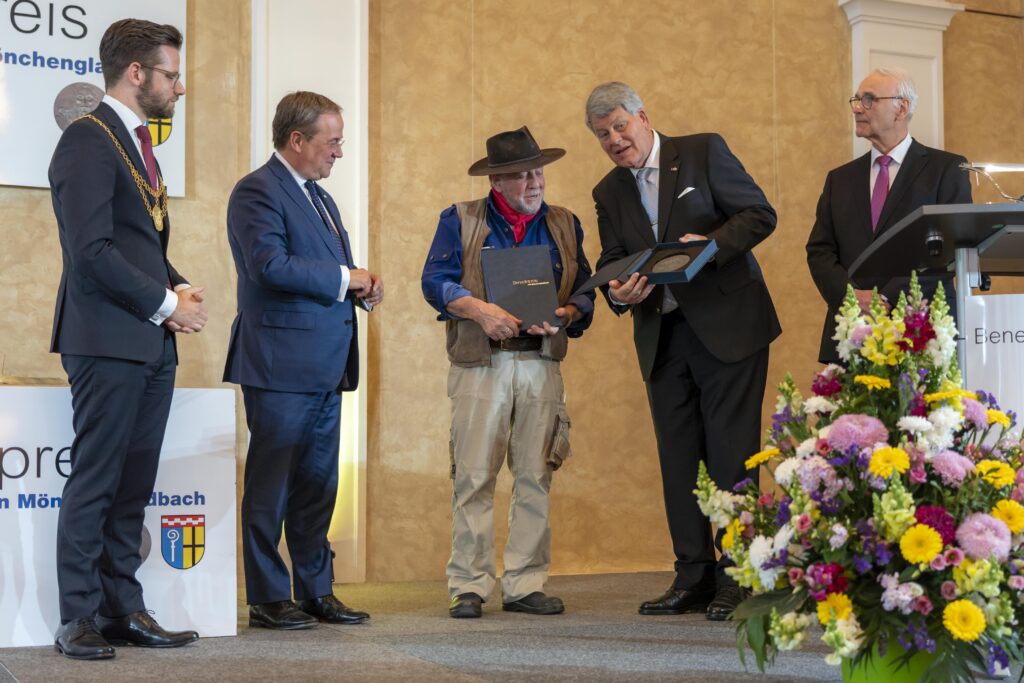
It is the final sentence of the evening at the ceremony in Haus Erholung that encapsulates everything: “If you want to read the stones, you inevitably have to bow before the victims,” says Gunter Demnig. The artist has just received one of the most important awards in the state of North Rhine-Westphalia: the Benediktpreis of Mönchengladbach. Endowed with 5,000 Euros, it is awarded to individuals “whose value-oriented actions stand out in a special way against the background of Christian-Western experiences.”
Demnig receives it for a project he began almost three decades ago. Throughout Europe, his Stolpersteine commemorate the victims of the Nazi dictatorship. At their last place of residence, he embeds brass memorial stones in the pavement, thus keeping alive the memory of people who lived there before they were abducted, expelled, and murdered by the National Socialists.
The 74-year-old has laid almost 90,000 such memorial stones across Europe, including in Ukraine and Russia. Most of them, however, are in Germany. In Mönchengladbach alone, 317 Stolpersteine have been laid at 97 locations since 2006, and last year, for the first time, a Stolperschwelle (stumbling threshold) was placed in front of the former Jewish retirement home at Friedrich-Ebert-Straße 82-84.
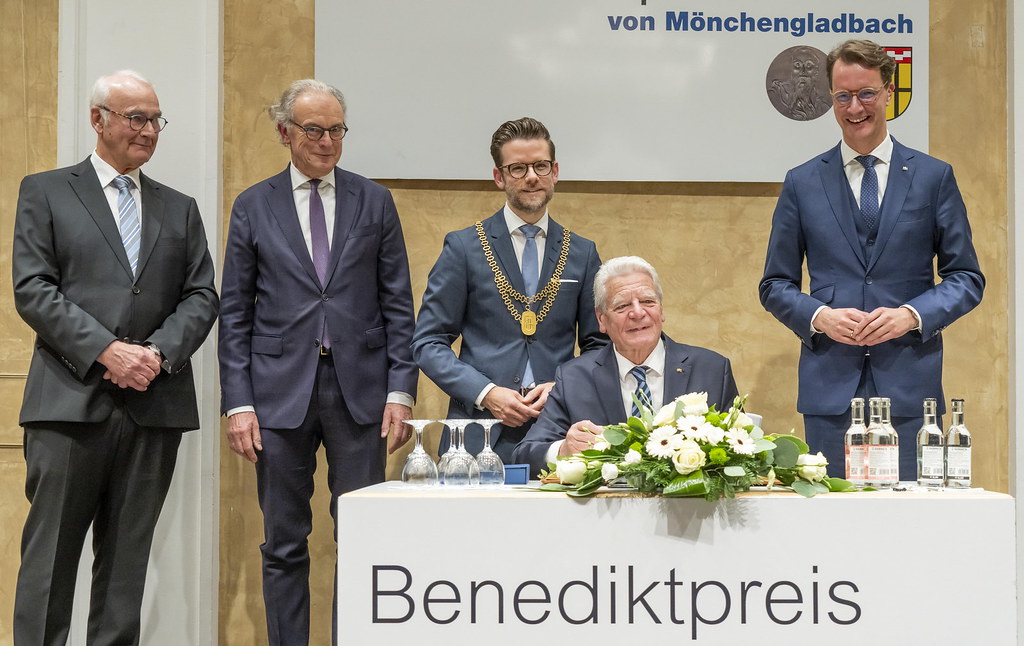
Demnig was actually supposed to receive the award in 2020. However, the pandemic thwarted the plans of the organizers, led by Helmut Linnenbrink from the “Benediktpreis von Mönchengladbach” association. The ceremony had to be postponed three times. On the fourth attempt, it worked out, according to Linnenbrink, who thanked the eulogist, former NRW Minister-President Armin Laschet, for his “reliability and loyalty to a given promise.”
Laschet used the presidential election in France to illustrate the importance of remembering the crimes of the past: “It didn’t take much for a far-right populist to become president.” The images of the war in Ukraine also showed that “it’s back.” Demnig’s Stolpersteine serve as a daily reminder of the horror that is possible. “They make you kneel before the victims of National Socialism and thus open our eyes,” the eulogist told the award winner.
Mayor Felix Heinrichs, a member of the board of trustees led by Prof. Ulrich Kania, attested that the honoree was “a man of conviction, belief, and courage.” With his “speaking stones,” Demnig encourages people to make a statement. The artist, on behalf of the millions unnamed, restores a piece of their dignity, Kania emphasized.
Just like the family of Ernst Adler. Ernst Adler spent the first ten years of his life in the house at Schillerstraße 50. It belonged to his family until August 1936. Then, as Jews disenfranchised and persecuted by the National Socialists, they had to emigrate to England. Two days ago, Adler came from Boston with his wife Ilana and daughter Tahlia to see Gunter Demnig, just a few hours before the ceremony, place four memorial stones for the family in front of their former home in Mönchengladbach: one each for his parents Max and Erna Adler, and for their children Ernst and Erika.
Despite jet lag, Ernst Adler is wide awake. May one ask how old he is? “You may ask,” says Adler and laughs. Later, he reveals that he will turn 96 in two weeks. And: “I hope to remember my time in Mönchengladbach better once the stones are laid.” Susan Worthington, his niece from Basel, also stands by Adler’s side. She will later deliver a moving eulogy for her grandfather.
Heinrichs is also present in the morning and says: “This is a special day for the city in this special place. I am filled with deep joy and gratitude to be able to welcome Ernst Adler himself.” Demnig takes his time with the laying, carefully embedding the stones in different types of sand. Musician Jürgen Löschner plays old Jewish folk songs on the saxophone.
When Demnig has completed his work, Ernst Adler kneels before it and reads. “All names spelled correctly,” he says, visibly moved. Someone places a single white rose next to the stones. Gabbai Boris Gerskovic from the synagogue recites “El Male Rachamem” in memory of the six million Jews murdered in the concentration camps. Heinrichs thanks everyone who accompanied this touching laying, including Leah Floh, chairwoman of the Jewish community, and representatives of the Society for Christian-Jewish Cooperation. Ernst Adler and his family want to spend a few m
ore days in the Rhineland. Then they will return to Boston and Basel.
At the ceremony, he and his family sit in the front row for the awarding of the Benediktpreis of Mönchengladbach. Surrounded by about 200 invited guests. Among them are the state’s Antisemitism Commissioner, Sabine Leutheusser-Schnarrenberger, the Vice President of the State Parliament, Carina Gödecke, State Secretary Christoph Dammermann, and numerous city dignitaries.